


Digitalisation is transforming labour markets and altering labour relations. This has laid the foundations for the rise of digital labour platforms, which connect the supply and demand for labour. The growth of digital labour platforms has created additional income-generating opportunities for workers around the world but has also given rise to several challenges for work and health. Multiple features of digital labour platforms, such as algorithmic management (automated processes that assign, monitor and evaluate work), working hours or income have the potential to impact the health of workers engaged in platforms. Surprisingly, the Occupational Safety and Health (OSH) implications of platform work have remained largely under the radar.
Therefore, this project has two aims: 1. to examine the occupational safety and health risks and regulations of platform work, and 2. to provide recommendations to foster a safe and healthy occupational environment for platform workers in Europe.
The project uses a study design which include (both) interview methods and statistics involving platform workers living in Belgium, Denmark, Finland, Poland, Spain, Sweden and the United Kingdom.
The expected results of this project will provide new and original scientific understanding of this understudied and evolving challenge for the future world of work. The new understandings from the project will offer new guidance for policymakers, companies and trade unions to protect the health of the European workforce.
KEYWORDS:
digital platform work, occupational safety and health, mixed-method, new world of work, algorithmic management, gig economy, non-standard employment, occupational hazards
CONSORTIUM
- Project Leader: Theo Bodin, Karolinska Institutet, The Institute of Environmental Medicine, Sweden, e-mail
- Trine Pernille Larsen, University of Copenhagen, Department of Sociology, Denmark
- Christophe Vanroelen, Vrije Universiteit Brussel, Interface Demography, Department of Sociology, Belgium, e-mail
- Chris Warhurst, University of Warwick, Institute for Employment Research, United Kingdom, e-mail
- Meike Brodersen, Université libre de Bruxelles, Belgium
- Dorota Merecz-Kot, University of Lodz, Institute of Psychology, Poland
- Lauri Kokkinen, Tampere University, Faculty of Social Sciences, Finland
- Mireia Julià, Fundació Institut Hospital del Mar d’Investigacions Mèdiques (IMIM), Social Determinants and Education on Health, Spain, e-mail
- Joan Benach, Pompeu Fabra University, Research Group on Health Inequalities, Environment, and Employment Conditions (GREDS), Spain
COOPERATION PARTERS
- Malin Wreder, Head of Department for Education, Welfare and The Labour Market, The Swedish Trade Union Confederation
- Dominik Sczukocki, The National Science Section (KSN) “Solidarność”, NSZZ
- Dolors Llobet i Maria, Coordination Direction CCOO of Catalonia, Comissió Obrera Nacional de Catalunya (CCOO)
- Elena Juanola Pagès, The Catalan Institute of Occupational Safety and Health, Institut Català de Seguretat i Salut Laboral
- G. Barbara Skorupa, Health and Safety Work, The Association of Workers of the Occupational Safety and Health Services
- Kirstine Baloti, The Union of Commercial and Clerical Employees in Denmark (HK)
- Martin Willems, National Head ACV-CSC United Freelancers, United freelancers
EFFECTS & ACHIEVEMENTS
Project achievements:
- Background
Digital platform work — such as food delivery, ride-hailing, and online freelancing — is expanding across Europe. While often described as flexible, it frequently involves unstable income, limited social protection, and unclear responsibility for workers’ health and safety. The GIG-OSH project examines how these conditions affect platform workers’ health, safety, and well-being across seven European countries.
- Methodology
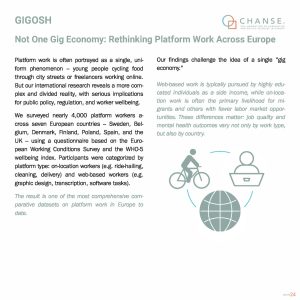
The project combines surveys and interviews in Belgium, Denmark, Finland, Poland, Spain, Sweden, and the United Kingdom. Nearly 4,000 platform workers completed surveys on working conditions, income, management practices, and health. In addition, 125 workers took part in interviews about their work experiences, risks, and future prospects. Comparing results across countries allowed researchers to identify shared problems and national differences.
- Key Findings and Impact
Main Findings
1) Low and unstable income
Platform workers earn on average about 20% of the national median income from platform work. Many work long hours or hold multiple jobs to maintain a basic income.
2) Job quality — not platform type — drives well-being
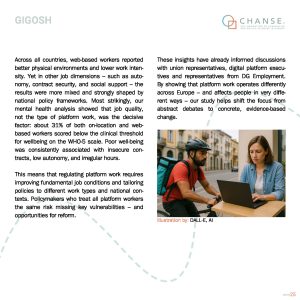
Working conditions such as predictable hours, social support, workload, and safety are key to workers’ well-being. Mental health differences are explained mainly by these job quality factors, rather than whether work is online or on-location.
3) High work intensity and unpredictable hours
Workers often face tight deadlines, rating systems, and pressure to accept tasks quickly. Unpredictable schedules and unpaid waiting time increase stress and fatigue.
4) Exposure to risks and unsafe conditions
On-location workers face traffic dangers, physical strain, and client aggression. Online workers experience long periods of isolation and screen-related strain. Both situations are linked to poorer health.
5) Economic dependence increases health risks
Workers who rely heavily on platform income are more likely to skip breaks, work while ill, or take safety risks to secure earnings.
6) Limited control despite self-employment status
Although classified as independent, workers often cannot influence pay, task allocation, or safety conditions. Protective measures, such as slowing down or buying equipment, can reduce earnings.
7) Uncertainty encourages overwork
Unpredictable demand and opaque algorithms push workers to remain constantly available. For those with few alternatives, this creates a cycle of overwork and increasing dependence on platform income.
Impact
The findings show that improving job quality — including predictable working time, safer conditions, income stability, and social support — is essential to protect platform workers’ health.
They also demonstrate that platform workers are not a homogeneous group. Risks and working conditions vary by type of platform work, level of economic dependence, and national labour protections. Policies and interventions therefore need to be tailored rather than based on one-size-fits-all assumptions.
The results further show that focusing only on employment status (self-employed vs. employee) is insufficient. Health risks arise from how work is organised, including workload, pay systems, and algorithmic management.
These findings provide concrete evidence for policymakers designing labour regulations, for platforms developing safer work practices, and for public health efforts addressing new forms of precarious work in the digital economy.
Future research will follow workers over time to examine long-term health effects and the impact of new regulations.
Publications:
- Bodin, T., Baldauf, B., Belvis Costes, F. X., Gevaert, J., Girardi, S., Ilsøe, A., Julià, M., Larsen, T. P., Kokkinen, L., Lipinska-Grobelny, A., Lundh, F., Mangot-Sala, L., Matilla-Santander, N., Merecz-Kot, D., Nurmi , H., Paszkowska Rogacz, A., Sarter, K., Warhust, C., Verdaguer, S., Vicente-Castellví, E., On-Location vs. Web-Based: Unveiling Job Quality and Mental Wellbeing Disparities across European Platform Economies, New Technology, Work and Employment, 2026
- Belvis Costes, F. X., Vicente-Castellví, E., Verdaguer, S., Gutiérrez Zamora, M., Benach, J., Bodin, T., Gevaert, J., Girardi, S., Harris, J., Ilsøe, A., Larsen, T. P., Kokkinen, L., Lee, S., Lundh, F., Mangot-Sala, L., Matilla-Santander, N., Merecz-Kot, D., Nurmi, H., Warhust, C., Julià, M., Cohort profile: Description of the GIG-OSH longitudinal cohort on occupational safety and health of digital platforms workers in Europe, BMJ Open, 2026
- Bodin, T., Larsen, T. P, Brodersen, M., Merecz-Kot, D., Kokkinen, L., Lundh, F., Matilla-Santander, N., Girardi, S., Baldauf, B., Sarter, K., Nurmi, H., Padrosa, E., Muntane, F., The invisible hamster wheel–uncertainty and health in digital platforms, 2026
- Bodin, T., Larsen, T. P, Brodersen, M., Padrosa, E., Matilla-Santander, N., Gevaert, J., Warhust, C., Baldauf, B., Ilsøe, A., Sarter, K., Merecz-Kot, D., Kokkinen, L., The constrained entrepreneur: How platform workers navigate the challenges of safeguarding health and safety, New Technology, Work and Employment, 2026
- Bodin, T., Larsen, T. P., Lundh, F., Mangot-Sala, L., Gevaert, J., Girardi, S., Harris, J., Ilsøe, A., Kokkinen, L., Lee, S., Lipinska-Grobelny, A., Nurmi , H., Julià, M., Verdaguer, S., Vicente-Castellví, E., Warhust, C., Matilla-Santander, N., Platform Dependency Across Web-based and On-location Platform Work: Associations with Occupational Accidents, Physical and Mental Health Among European Platform Workers, Social Science and Medicine, 2026
- Bodin, T., Larsen, T. P., Merecz-Kot, D., Kokkinen, L., Julià, M., Lundh, F., Matilla-Santander, N., Mangot-Sala, L., Gevaert, J., Lee, S., Sarter, K., Warhust, C., Paszkowska Rogacz, A., Lipinska-Grobelny, A., Thern E., Znajmiecka M., Zwardoń-Kuchciak O., Analysis of Psychosocial Job Demands and Resourcesand Their Relations to Wellbeing in On-Site and Web-Based Platform Work Across Europe – Findings from the GIG-OSH Study, BMJ Open, 2026
- Warhust, C., Baldauf, B., Lundh, F., Matilla-Santander, N., Hakansta, C., Escrig Pinol, A., Muntane, F., Joukovsky, A., Brodersen, M., Gevaert, J., Oelbrandt, E., Merecz-Kot, D., Lipinska-Grobelny, A., Paszkowska Rogacz, A., Ilsøe, A., Larsen, T. P., Kokkinen, L., Nurmi, H., Perkiö, M., Gunn V., Znajmiecka M., Zwardon-Kuchciak O., Malinowska N., Venäläinen L., Atkins, S., Koivusalo, M., Country-specific Stock-Taking Reports: Regulating Occupational Safety and Health in the Platform Economy, web repository KI librar, 2026
 Start date
1 November 2022
 Project duration
36 months
 Project budget
€ 1 646 837
Funding organisations